

 English
 русский
 Español
 عربى
عربى


No. 8, Duxiu San Road, Ganlin Town, Shengzhou City, Shaoxing City, Zhejiang Province, China

News Category
Product Category
What kind of motor is used in air coolers?
Content
Select energy efficient, reliable, and durable components for residential, commercial, or industrial evaporative cooling systems requires a thorough understanding of electric drive mechanisms. At the core of every evaporative air cooler lies the drive assembly responsible for forcing ambient air through damp cooling pads. The efficiency, noise profile, speed adjustability, and overall lifespan of an air cooler depend heavily on the specific design of Air Cooler Fan Motors.
Different cooling applications require distinct electrical and mechanical motor profiles. Smaller personal desktop coolers utilize lightweight, low torque designs, while commercial evaporative cooling towers rely on heavy duty industrial units capable of moving massive air volumes against high static pressure. Examining the fundamental electric motor architectures, internal material choices, speed regulation systems, and failure modes provides clear insight into how Air Cooler Fan Motors operate within humid air cooling environments.
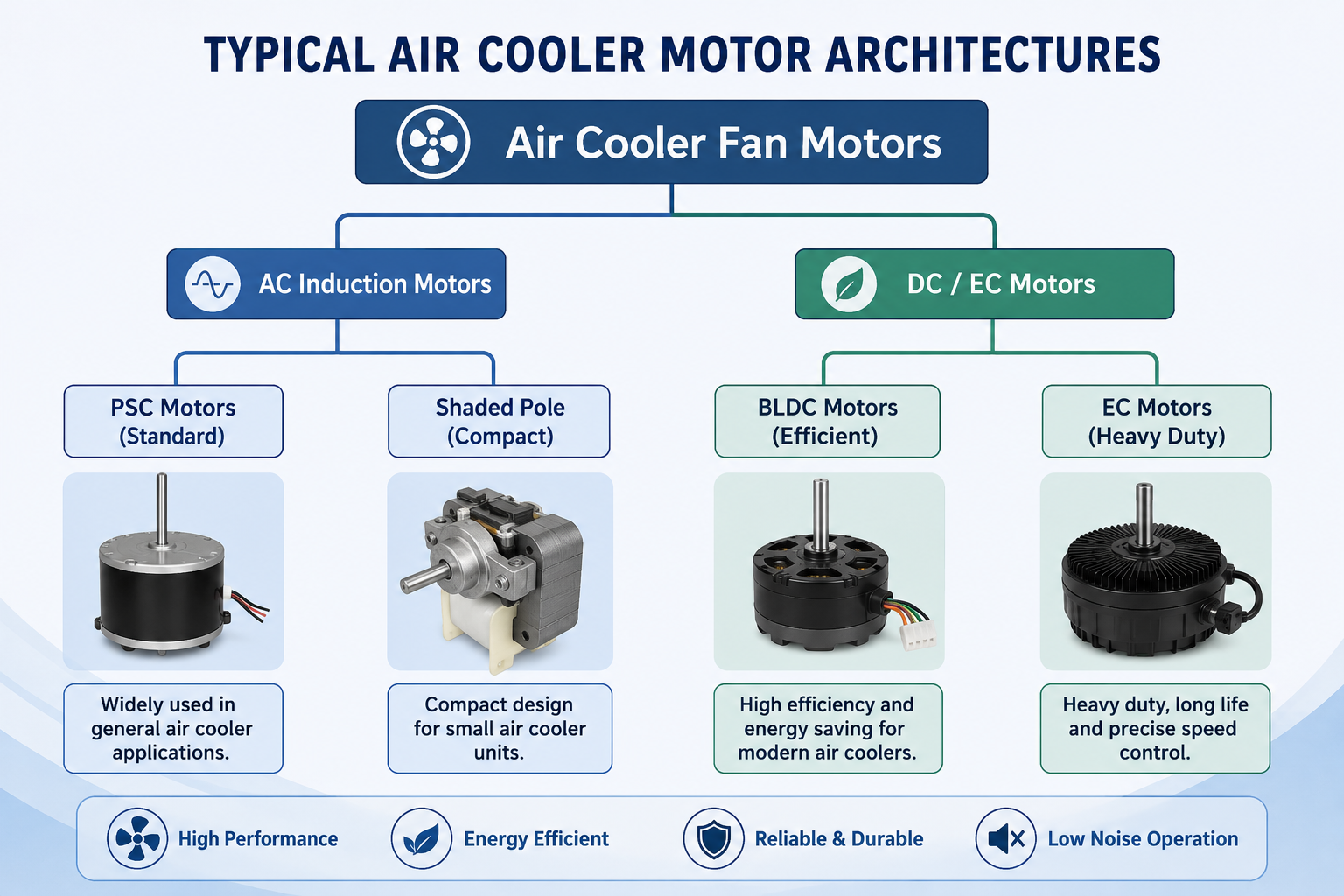
Primary Types of Air Cooler Fan Motors
Electric motors used in evaporative cooling devices belong to two major electrical categories, namely alternating current induction motors and electronically commuted or direct current motors. The operational mechanics, torque output, energy utilization, and physical construction vary substantially across these motor families.
Permanent Split Capacitor Motors in Traditional Evaporative Coolers
Permanent split capacitor motors, frequently designated as PSC motors, represent the most widespread drive technology found in standard residential and commercial evaporative air coolers. A permanent split capacitor motor is a single phase alternating current induction motor that incorporates a run capacitor connected in series with an auxiliary stator winding. This capacitor remains energized continuously while the motor operates, maintaining a constant phase shift between the main winding and the auxiliary winding.
The continuous phase displacement created by the run capacitor establishes a uniform rotating magnetic field within the stator core. This rotating field induces current within the squirrel cage rotor, producing smooth rotational torque with minimal electrical ripple. PSC Air Cooler Fan Motors offer a favorable balance between manufacturing cost, electrical efficiency, and operational reliability. Because they contain no mechanical starting switches or centrifugal contacts that can wear out or spark, PSC motors demonstrate high reliability in damp environments.
PSC motors used in air coolers typically offer medium starting torque and smooth running characteristics. The stator windings are often designed with intermediate electrical taps, enabling simple multi speed operation by changing connection points on a selector switch. This capability makes permanent split capacitor drive units ideal for multi speed residential room coolers that require high, medium, and low airflow settings.
Shaded Pole Motors in Small Portable Air Coolers
Shaded pole motors represent an economical, ultra simple single phase alternating current motor design utilized primarily in low power, personal, or compact portable air coolers. The mechanical construction of a shaded pole motor consists of salient stator poles, where a portion of each pole piece is encircled by a small, closed copper loop known as a shading coil or shading ring.
When alternating current passes through the main stator winding, the changing magnetic flux induces an opposing current in the copper shading ring. This induced current delays the magnetic flux build up across the shaded portion of the pole piece relative to the unshaded section. The resulting time delay generates a weak, shifting magnetic field across the pole face, providing sufficient directional torque to start rotor rotation.
Despite their simple construction and low manufacturing cost, shaded pole Air Cooler Fan Motors exhibit low electrical efficiency. A significant portion of the input electrical energy is converted into heat within the stator windings and shading rings rather than mechanical rotation. Consequently, shaded pole designs are limited to small fan impellers requiring low wattage input, such as desk coolers, small room spot coolers, and portable mini evaporative units where low initial product cost takes precedence over energy consumption.
Brushless Direct Current Motors in Modern Energy Efficient Coolers
Brushless direct current motors, commonly referred to as BLDC motors, represent a major technological shift in high efficiency evaporative cooling systems. Unlike conventional alternating current induction motors, a BLDC motor utilizes permanent magnets mounted on the rotor, while the stator contains concentrated copper coil windings. Mechanical brushes and physical commutators are completely eliminated.
Rotation in a BLDC motor is achieved through electronic commutation managed by an integrated or external electronic controller. The controller continuously monitors rotor position using internal Hall effect sensors or by tracking back electromotive force voltage signals from the unenergized stator phases. By energizing specific stator coils in a precise sequential pattern, the electronic controller pulls the permanent magnet rotor around the shaft axis continuously.
BLDC Air Cooler Fan Motors provide exceptionally high energy conversion efficiency across their entire operational speed range. Because the magnetic field of the rotor originates from permanent magnets rather than induced electrical currents, internal rotor electrical losses are virtually eliminated. This reduced internal power dissipation keeps BLDC motors cool during continuous operation, significantly extending bearing lubricant life and winding insulation integrity. Furthermore, BLDC systems allow seamless, stepless speed adjustment using digital pulse width modulation signals, enabling precise airflow management in smart evaporative coolers.
Electronically Commutated Motors for Heavy Duty Evaporative Systems
Electronically commutated motors, often called EC motors, combine alternating current power input flexibility with the high efficiency of direct current internal operation. An EC motor plugs directly into standard single phase or three phase alternating current mains supplies, utilizing an integrated internal power converter to transform alternating current into direct current before driving a brushless motor structure.
EC Air Cooler Fan Motors feature built in microprocessors that manage electronic commutation, active power factor correction, and closed loop speed control. In demanding commercial and industrial evaporative cooling installations, air resistance across thick damp pads can fluctuate as minerals build up or pads become saturated. An EC motor can monitor internal working loads and automatically adjust shaft torque and rotational speed to maintain constant airflow volume regardless of changing static pressure resistance.
While the upfront cost of an EC motor assembly is higher than a traditional single phase induction motor, the reduction in lifetime electrical power consumption, lower operating temperatures, and built in thermal protection mechanisms make EC technology highly cost effective for large scale agricultural, industrial, and commercial evaporative cooling facilities.
Key Electrical and Mechanical Components of Air Cooler Fan Motors
The performance and environmental resilience of an air cooler motor depend on the structural materials, lubrication systems, and protective enclosures integrated into its physical frame.
Copper versus Aluminum Stator Windings
The electrical conductor material used in the stator coils directly influences the thermal characteristics, electrical resistance, and longevity of Air Cooler Fan Motors. Copper and aluminum represent the two primary magnet wire materials utilized by motor manufacturers.
Copper possesses superior electrical conductivity and lower volumetric resistance compared to aluminum. Stator coils wound with magnet grade copper wire generate less internal resistance heat for a given current draw, allowing the motor to run cooler under heavy mechanical loads. Furthermore, copper exhibits high mechanical tensile strength and strong resistance to galvanic corrosion, making copper wound motors resilient against moist, high humidity airflow inside evaporative cooler cabinets.
Aluminum magnet wire offers a lightweight and low cost alternative to copper. However, because aluminum exhibits lower electrical conductivity, aluminum wound motors require thicker wire gauges to carry equivalent electrical currents. This larger wire volume requires wider stator slots and a larger overall motor frame size. Aluminum is also more susceptible to thermal expansion cycles, mechanical embrittlement, and oxidation at terminal electrical connections. If moisture penetrates the motor housing, aluminum windings can undergo rapid surface oxidation, potentially leading to premature electrical short circuits unless high grade protective varnish coatings are applied.
Bearing Systems and Lubrication Architectures
The internal rotational support mechanism holding the motor shaft determines the acoustic output, physical shaft alignment, and operational life of an air cooler motor. Manufacturers primarily employ either sleeve bearings or precision ball bearings based on duty cycles and cost constraints.
-
Sleeve Bearings: Consist of a polished steel shaft rotating inside a porous sintered bronze bushing impregnated with lubricating oil. Fluid dynamic forces create a micro thin oil film between the spinning shaft and the stationary bushing during operation. Sleeve bearings deliver ultra quiet acoustic performance, making them popular in residential indoor evaporative coolers. However, they require clean environments, offer lower axial thrust load capacity, and can dry out if the motor operates continuously in high temperature environments without re-lubrication.
-
Precision Ball Bearings: Incorporate hardened steel or ceramic balls riding between inner and outer ground steel raceways. Ball bearings are packed with high temperature synthetic grease and sealed with rubber lip seals or metal shields. Ball bearing Air Cooler Fan Motors handle higher radial and axial mechanical loads, maintain precise shaft alignment under belt tension, and withstand continuous high temperature operation without lubricant loss. Ball bearings are the standard choice for commercial evaporative coolers, outdoor industrial units, and heavy duty fan assemblies.
Motor Enclosure Ratings and Moisture Protection Engineering
Because air cooler motors operate in close proximity to water distribution trays, wet evaporative media, and saturated discharge air, the physical motor enclosure must prevent water ingress and internal core corrosion.
Standard industrial ingress protection ratings designate the sealing capability of electrical enclosures. Air Cooler Fan Motors frequently utilize Open Drip Proof structures, designated as IP22 or IP23, or Totally Enclosed Fan Cooled structures, designated as IP44, IP54, or IP55.
Open Drip Proof motor housings feature ventilation slots designed so that liquid drops falling within a fifteen degree angle from vertical cannot enter the internal electrical compartment. Internal cooling fan blades mounted on the rotor draw cooling air directly through the motor interior. These units are suitable for dry side evaporative cooler designs where the motor is shielded from direct water splash.
Totally Enclosed Fan Cooled housings isolate internal electrical components, stator laminations, and rotor assemblies completely from external ambient air. Cooling is achieved by an external shaft mounted fan that blows ambient air over extruded cooling fins cast into the outer aluminum or iron frame. Totally enclosed designs prevent damp air, water droplets, and mineral dust from contacting the internal stator windings, providing superior service life in high humidity environments.
In addition to housing seals, high quality air cooler motors undergo specialized varnish encapsulation. Stator assemblies are processed through vacuum pressure impregnation using anti-fungal epoxy resins. This resin coating bonds the copper wires firmly together, eliminating vibrational insulation chafing while creating an airtight moisture barrier across the stator laminations.
Motor Speed Control Mechanics and System Integration
Regulating fan motor speed allows evaporative air coolers to match changing ambient thermal conditions, manage room humidity levels, and reduce electrical energy consumption during cool evening hours.
Tapped Stator Winding Multi Speed Control
In traditional alternating current PSC Air Cooler Fan Motors, speed regulation is achieved by altering the effective number of active turns within the stator winding circuit. Motor manufacturers build intermediate wire taps directly into the main stator winding during the automatic winding process.
When the user selects high speed operation, electrical current is routed through the primary main winding connection, utilizing the lowest number of stator turns. This setup produces maximum magnetic field strength, minimal magnetic slip, and full rated rotor shaft revolutions per minute.
When the selector switch transitions to medium or low speed settings, electrical current flows through additional winding turns incorporated into the stator circuit. Adding these extra wire turns increases the total electrical inductive impedance of the stator assembly, reducing the effective voltage applied across the primary winding. The reduced magnetic field strength increases rotor slip relative to the line frequency, causing the fan impeller to rotate at a lower speed. This method is highly reliable and inexpensive, though energy efficiency decreases on lower speed settings because excess energy is dissipated as magnetic slip losses.
Pulse Width Modulation and Electronic Frequency Regulation
Modern BLDC and EC Air Cooler Fan Motors bypass mechanical winding taps entirely, utilizing digital pulse width modulation or variable frequency drive algorithms to adjust rotational speed.
Pulse width modulation operates by switching the direct current power supply feeding the stator phases on and off at high frequencies, often exceeding twenty kilohertz. By varying the duty cycle, which represents the ratio of power on time versus total switching period, the electronic controller regulates the average voltage and current supplied to the motor coils. A shorter duty cycle delivers lower average power, smoothly slowing the permanent magnet rotor without generating electrical slip heat.
Electronic frequency regulation allows seamless speed adjustment from zero to full rated shaft speed. This stepless speed capability enables smart air coolers to continuously modulate airflow based on room humidity readings, ambient temperature sensors, or user programmed comfort algorithms.
Interlocking Control Systems with Water Pumps and Sensors
In complete evaporative cooling systems, the fan motor operates as part of an integrated electromechanical circuit that includes water circulation pumps, water level float switches, and automated drain valves.
Advanced evaporative cooler control boards enforce pre-soak timing sequences during system startup. When the user turns on the cooler, the control board energizes the water pump first while holding the Air Cooler Fan Motor in a dormant off state for several minutes. The pump circulates water across the evaporative cooling pads until the media is thoroughly saturated.
Once the pre-soak timer completes, the control board energizes the fan motor. Pre-soaking prevents the fan from blowing dry, warm, dust laden ambient air into the living space during initial startup. Additionally, safety interlock switches monitor water reservoir levels. If the water supply dries up, the control board can alter fan motor operational speeds or trigger alert warnings to prevent the unit from operating inefficiently under dry conditions.
Operational Challenges and Failure Mechanics in Air Cooler Fan Motors
Air cooler motors operate under challenging ambient conditions characterized by continuous high relative humidity, airborne dust accumulation, mineral scale exposure, and high ambient summer temperatures. Understanding common failure mechanics helps in specifying durable motor designs.
Thermal Overload and Insulation Breakdown
Excessive heat generation remains a major cause of winding insulation failure in Air Cooler Fan Motors. When an evaporative cooler operates during extreme heatwaves, ambient air entering the cabinet offers reduced cooling capacity for the motor frame itself.
If the fan impeller becomes clogged with lint, or if mineral deposits weigh down the cooling pads and restrict airflow pathways, the static backpressure inside the cooler housing increases. This added mechanical resistance forces the motor to draw higher current levels, accelerating internal copper resistance heat loss.
Continuous elevated temperatures degrade the thin enamel varnish coating applied over the stator magnet wires. Over time, the varnish becomes brittle, develops microscopic cracks, and allows adjacent wire turns to short-circuit together. To prevent catastrophic winding burnouts, modern air cooler motors incorporate thermal overload protectors. These thermal switches, mounted directly against the stator copper coils, cut off electrical power automatically if internal winding temperatures exceed safe operational thresholds, usually rated around one hundred and thirty degrees Celsius for Class B insulation or one hundred and fifty-five degrees Celsius for Class F insulation systems.
Moisture Ingress and Stator Corrosion Dynamics
The environment inside an evaporative air cooler cabinet routinely reaches relative humidity levels exceeding eighty to ninety percent. During operational off cycles, ambient moisture condenses on cold metallic motor components, including the stator lamination stack, rotor core, and internal bearing housings.
If moisture penetrates unsealed areas of the stator assembly, it reacts with iron laminations, forming iron oxide rust. Rust formation causes individual silicon steel laminations to swell and separate, a process known as lamination jacking. This physical expansion increases internal eddy current electrical losses, leading to elevated operating temperatures even under light loads. Furthermore, moisture combined with airborne mineral salts forms a conductive liquid film across internal wire splices, eventually triggering ground fault short circuits to the grounded outer frame.
Mechanical Wear and Bearing Lockup
Mechanical failure in Air Cooler Fan Motors often originates from bearing degradation caused by environmental contaminants or incorrect physical tensioning.
In belt driven commercial evaporative coolers, an over tightened drive belt exerts severe lateral radial forces on the motor shaft bearings. This excessive side load wears down sleeve bushings unevenly, creating an oval shaped shaft clearance that causes rotor misalignment. Once the rotor shifts off center, magnetic pull forces pull the rotor directly against the stator teeth, resulting in mechanical lockup and rapid motor burnout.
In direct drive systems, airborne dust particles, mineral scale flakes from evaporating water, and fine sand can pass through unsealed bearing caps. These abrasive particles mix with internal bearing grease, turning the lubricant into a grinding paste that rapidly destroys polished steel raceways. As bearing friction increases, the motor generates loud squeal or hum noises, experiences severe shaft vibration, and eventually seizes completely.
Selection Guidelines for Replacement and Engineering Integration
Replacing a worn air cooler motor or specifying a drive unit for a new evaporative cooler design requires precise matching of mechanical frame dimensions, mounting geometry, and electrical ratings.
Matching Frame Sizes Shaft Dimensions and Mounting Styles
Physical mounting configurations for Air Cooler Fan Motors generally fall into four primary structural categories:
-
Resilient Ring Cradle Mounts: The motor end shields incorporate thick rubber rings that rest inside a stamped steel cradle base. The rubber rings absorb torsional motor vibration, preventing high frequency hum from transmitting into the sheet metal air cooler cabinet.
-
Belly-Band Mounts: A flexible steel strap clamps tightly around the outer cylindrical perimeter of the motor housing. Attachment legs welded to the belly-band bolt directly to the air cooler fan housing shroud.
-
Rigid Stud Mounts: Extended threaded steel studs protrude directly from the front or rear end shield of the motor, passing through matching holes on the fan housing bracket.
-
Rigid Base Mounts: A heavy steel mounting foot is welded or cast directly onto the bottom of the main motor frame, featuring standard bolt slot dimensions.
Alongside the mounting configuration, shaft physical dimensions must match the fan hub specifications precisely. Key parameters include total shaft length, shaft diameter, and flat keyway profiles. Double shaft motors, which feature extended drive shafts protruding from both the front and rear end shields, are utilized in dual centrifugal blower coolers where a single motor drives two separate impellers simultaneously.
Electrical Rating Alignment and Capacitor Sizing
Replacing an air cooler motor requires verifying that all electrical operating parameters align with the regional power supply and system controller capabilities.
-
Supply Voltage and Frequency: Standard single phase residential units operate on either one hundred and fifteen volts or two hundred and thirty volts at fifty or sixty hertz line frequency. Industrial evaporative coolers often require three phase power supplies operating at four hundred or four hundred and eighty volts.
-
Full Load Amperage: The current rating printed on the motor nameplate reflects the maximum continuous current draw at full rated load. Internal wiring fuses, thermal switches, and electronic control relays must be rated to handle this full load current without nuisance tripping.
-
Capacitor Microfarad Matching: For PSC Air Cooler Fan Motors, replacing a failed run capacitor requires selecting a replacement unit with the exact microfarad capacitance value specified on the motor nameplate. Installing a capacitor with a microfarad rating that is too low reduces starting torque and lowers motor speed. Conversely, installing a capacitor with a microfarad rating that is too high increases current flow through the auxiliary winding, causing severe motor overheating and rapid winding insulation failure. Voltage ratings on replacement capacitors should always meet or exceed the original manufacturer specification to prevent dielectric breakdown.
 Ready To Customise
 Your Motor Products?

We are professional motor manufacturers, delivering powerful, stable, and efficient power cores for all industries through precision craftsmanship and innovation.
Contact Us
-
 Mobile:+86 13575536911
-
 Tel:+86 18357538240
-
 Whatsapp:+8618357538240
-
 Email:betty@dbjxmotor.com
-
 Company Address
Copyright © by Shengzhou Jiangxin Motor Technology Co., Ltd. All Rights Reserved.
Wholesale Industrial Fan Motors Manufacturers
